ISFB Insight
Family Office: People at the Heart of Wealth Management
September 24, 2026
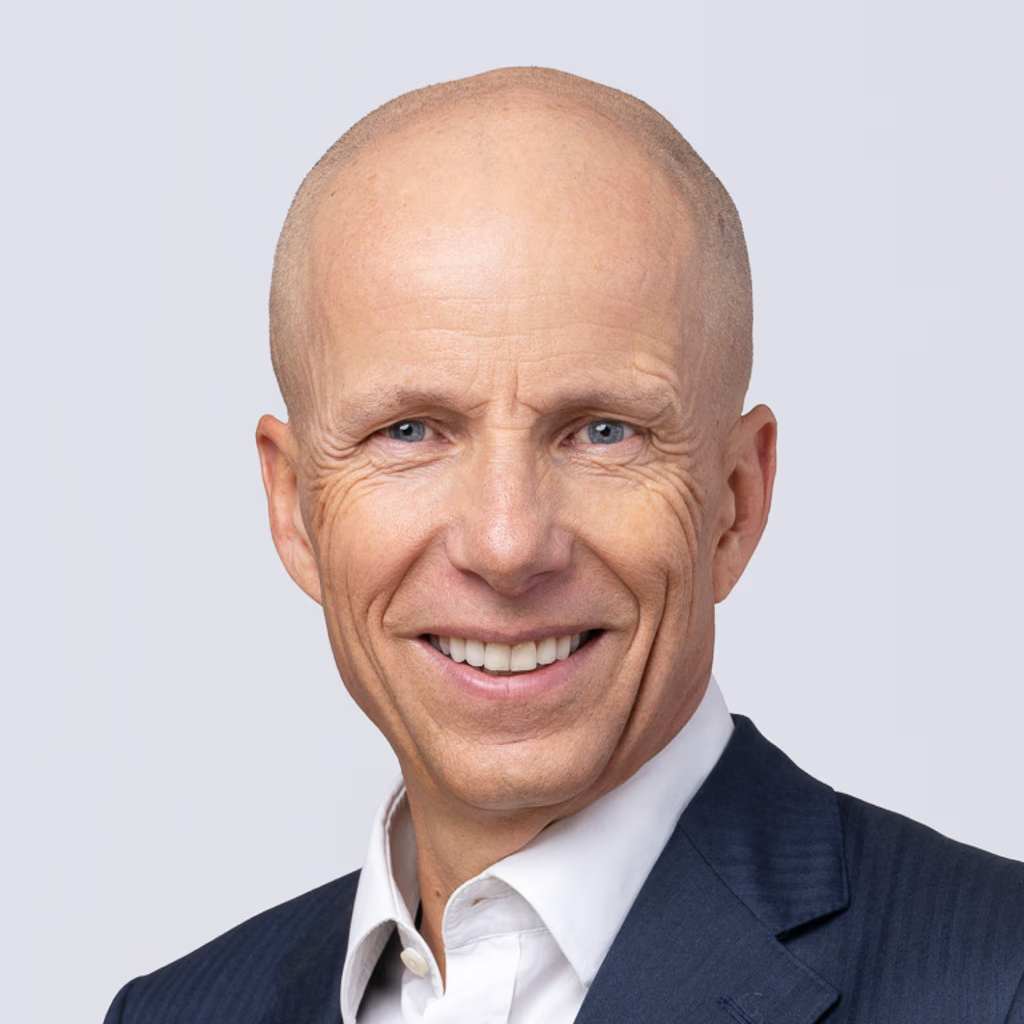
Today, high-net-worth families expect more than just asset management. They are looking for a framework and a point of contact capable of connecting what they own with who they are. An interview with Pierre Ricq, Director of the ISFB Family Officer Certificate Program.
Why has the Family Office approach emerged today as a natural solution to families’ needs?
Because wealth management goes far beyond asset allocation. A family faces financial, legal, tax, and intergenerational challenges that are best addressed holistically. The Family Office approach offers this coordinated and sustainable big-picture perspective. It starts with the family and its aspirations, ensuring that governance, wealth planning, and investments move forward in unison. Ultimately, families are looking for a point of reference—a place where someone takes the time to understand before making recommendations.
You often say that the human aspect of wealth comes before its financial aspect. What does this belief entail?
It all starts with listening. It’s about understanding a family’s history and dynamics, as well as the expectations each member holds without always expressing them. This patient process brings to light what unites the family and what is worth preserving. On this foundation, decisions find their legitimacy. I believe in positive intentionality. It’s a sincere commitment to the family’s values—values they feel even before they’re put into words. That’s what builds trust. The future of our profession will depend as much on the quality of our relationships as on the quality of our expertise.
What is this family dynamic that shapes the program?
A process that unfolds in three stages. The first involves understanding the family as a whole—its DNA, values, and mission. The second involves structuring the family by establishing clear governance where everyone knows their role. The third involves orchestrating the process by translating the family’s objectives into investments that flow naturally from the preceding steps. I like to point out that the family protocol is the family’s backbone and that its mission is its heart. After that, everything else falls into place naturally. The Family Officer acts as the conductor here. He or she does not play every instrument but ensures that lawyers, tax specialists, asset managers, and other experts perform the same piece at the right tempo. Isolated expertise provides only a partial solution.
The certificate program brings together participants from a wide variety of backgrounds. How does this diversity benefit the program?
She embodies this vision. The journey closely follows the three movements of the score. It begins with family DNA and governance, then extends into wealth planning and the world of investments—from private markets to sustainable investing. Finally, it gives intangible heritage its rightful place. Philanthropy becomes a catalyst for cohesion, and art serves as both a memory and an asset. We are fortunate to operate within a fertile ecosystem, where experts of exceptional caliber come together. Each module is led by one of these active practitioners. They don’t simply recite knowledge; they share their experience. A participant from the most recent cohort summed it up better than I ever could. He had come looking for training. He found a comprehensive perspective and instructors who spoke about the situations they encounter with families. He left with lessons directly applicable to real life.
Who is the ISFB Family Officer certification intended for today?
To everyone who wants to understand the world of family offices. To family members, whether founders or heirs. To professionals at single- and multi-family offices, as well as to wealth managers and bankers who work with high-net-worth families. The next session in French will begin this fall in Geneva.
The certificate recently inspired the ISFB NextGen Academy, a customized training program designed for family offices. Where did this initiative come from?
She drew inspiration from a conversation with a family office that wanted to offer the young members of the families it serves an experience true to the spirit of the certificate. We designed a fully customized two-day program for them. This time, the program brought together young adults aged 18 to 25. This generation wants to understand, learn, and get involved. They know expectations are placed on them and wish to be seen as active participants rather than mere heirs. Being asked about the meaning of a family’s wealth before discussing the numbers is a rare moment. This type of initiative confirms what we’ve long suspected: the process of passing on wealth begins long before the actual transfer of assets.
© Institut Supérieur de Formation Bancaire (ISFB). All rights reserved.
The analyses and content published by the ISFB may be quoted or reproduced in part, provided that the source is clearly mentioned. Any full or substantial reproduction of this article in another medium or format is subject to the prior written authorization of the ISFB. In order to facilitate reading and without any intention of discrimination, the masculine gender is generally used, in accordance with the grammatical rule that allows it to be used as a neutral value to refer to a group of people comprising both men and women. This publication is intended for ISFB members and their employees in Switzerland, as well as anyone interested in finance in Switzerland. It is not intended to be read or distributed in any jurisdiction where its distribution would be prohibited.