The Institute
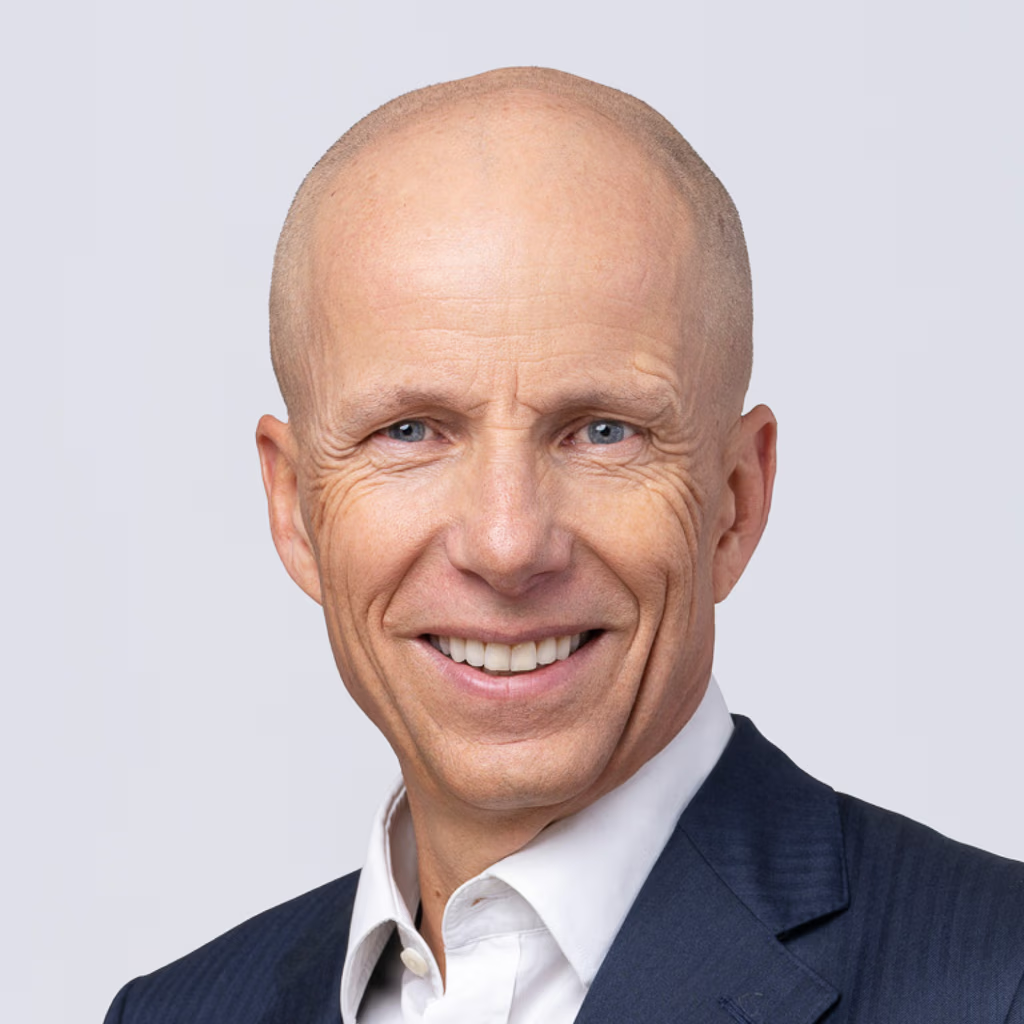
Interview with François Menzel (Valiant Bank): Credit, an essential pillar of the banking industry
February 27, 2025
In this interview, François Menzel shares with us his experience as a speaker and his vision of the issues surrounding credit and SME financing. Find out how the ISFB Crédits certificate meets training needs in this crucial area.
Mr. Menzel, you are a lecturer at ISFB, where you teach business transfers as part of the ISFB Credits certificate. Can you tell us about your experience as a lecturer?
Among other things, I run a training module on the subject of business transfers. It's a subject that's naturally very broad, since it involves knowledge of a large number of fields, such as finance, law, taxation and, more surprisingly, a certain knowledge of human psychology, since the transfer of a business is a highly emotional act, particularly for the seller. My aim with this course is to capture the interest of participants and inspire them to go further in the study of business transfers. In my field, we are constantly accompanying buyers and sellers through the long and complex process of transferring a business. Transposed to the course, this experience enables me to illustrate each topic with concrete examples, best practices and also examples not to be followed. It also gives me the opportunity to share my theoretical and practical knowledge with the participants, who naturally come to question experiences from the field.
Can you tell us about your academic and professional background?
I began my training with an apprenticeship in banking, which I completed a few years later with a Federal Banking Masters. I quickly moved into sales, as I've always had a passion for the economy and business. It's a field that requires in-depth knowledge of analysis and financing. As each company is different, even in a similar field of activity, it is essential to acquire a global understanding of all aspects of a company, so as to be able to propose solutions that are adapted to both the customer and the bank. This can hardly be learned other than through experience. Having worked in this field for many years, I've never stopped training and completed a CAS in Mergers & Acquisitions and Company Transfers at the HEIG VD. Then, motivated by the tax courses, I followed this up with a CAS in SME Taxation at the Haute Ecole Arc and the University of Neuchâtel. In my current role as regional manager for corporate clients in the French-speaking part of Switzerland, I have the pleasure of continuing to support entrepreneurs and their companies, while developing the SME advisory department at Banque Valiant, with my team of business advisory professionals.
What do you see as the main challenges in the area of credit and business transfers, and how does this program provide concrete solutions?
SMEs account for 80-90% of the Swiss economy. It is therefore extremely important for entrepreneurs and their businesses to be able to rely on a reliable and solid banking partner. Most SME financing is currently provided by traditional commercial banks. Of course, there is talk of crowdfunding, crowdlending and neobanking. These new forms of financing for SMEs exist and are developing, but to date they remain anecdotal, and we don't know how regulations will evolve. Banks have played, and will continue to play in the coming years, a crucial role in providing financial support to SMEs. The same applies to business transfers. Here too, banks play an essential role in supporting the transfer process, both for the buyer (advice, financing) and the seller (financial planning, contingency planning). In both good times and bad, it's important to have a stable, trusting relationship with your bank, which can then support you competently and effectively. For this to work, it's essential that corporate customer advisors and risk analysts alike have a thorough command of this vast field. The ISFB Credits certificate provides participants with a solid theoretical and practical foundation. I hope that this certificate, through its quality and the diversity of the areas taught, will enable some of the participants to find their vocation, as it is vital for our SMEs that the banks have a well-trained and competent succession.
What, in your opinion, are the strengths and specific features that make this program so rich and high quality?
The first point is that all courses are given by "militiamen" whose teaching is not their job, but who are driven by a passion for their profession and a desire to pass on their knowledge. Using practitioners also ensures that the courses are perfectly up to date and focused on practical cases and real-life experience. This makes the courses lively, and participants respond well to them. They become immersed in the teacher's everyday life. This naturally makes it easier to put the lessons into practice. While each bank has its own internal processes, there is little difference in substance.
As the subject of "credits" is so vast, it's a challenge to put together a program that's as comprehensive as possible over an 8-day period. By the end of the certificate, participants will have acquired a basic knowledge of most areas of financing.
Finally, I'd like to point out that prior to this certificate, there was virtually no training specifically focused on credit. Books on the subject are almost impossible to find in bookshops. With the introduction of this certificate, the ISFB has filled a gap in the field of banking training, with the seriousness and competence for which it is renowned. The certificate is recognized by ISFB member banks, and meets a real need in terms of developing knowledge and know-how in the credit field.