Continuing Education
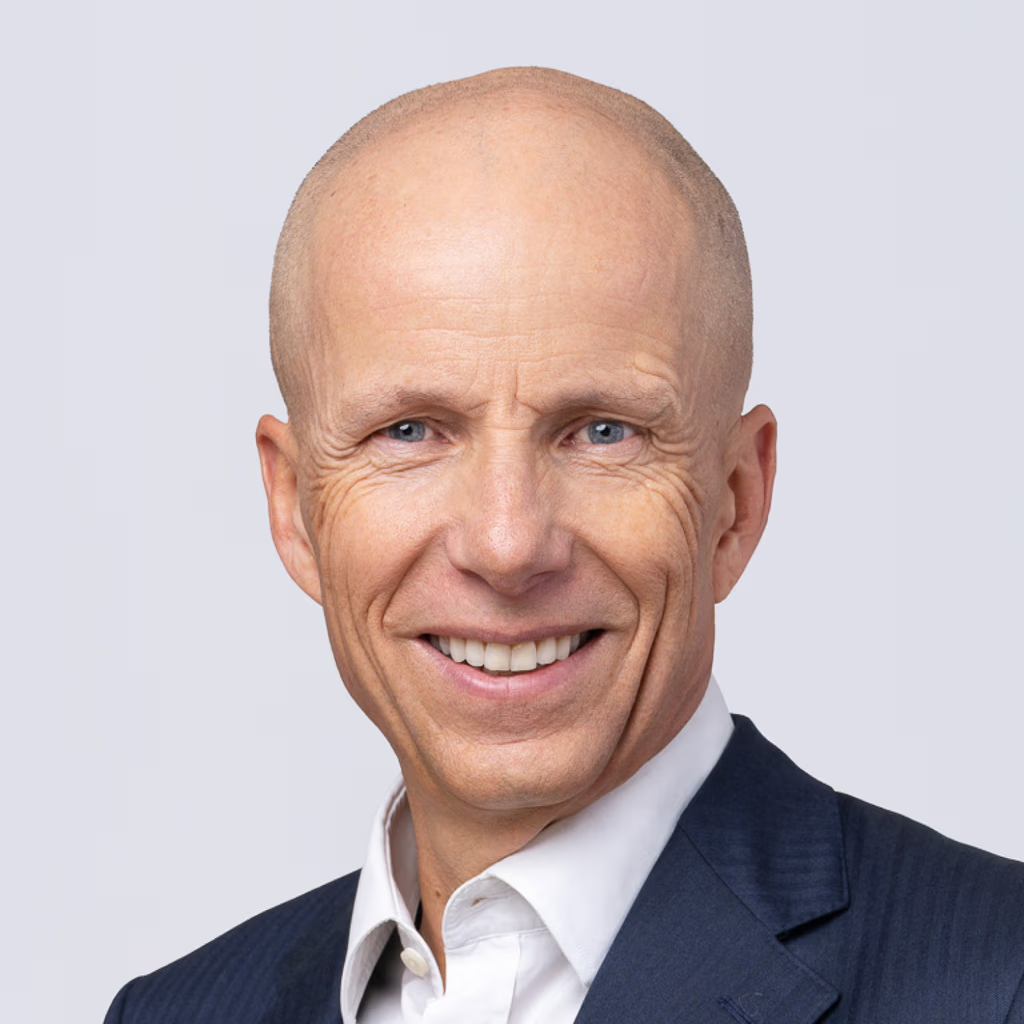
Passing on, inspiring, supporting: the commitment of Jan Grossen, lecturer in the ISFB Management Assistant certificate program.
July 1, 2025
For over ten years, Jan Grossen has been sharing his expertise within the ISFB training courses. As a lecturer in the Asset Management Assistant certificate program, he talks about his career path, his commitment to teaching, the challenges of the profession and the concrete benefits of this training program, designed to support the development of asset management assistants.
Jan Grossen, you are a lecturer at ISFB, where you teach as part of the ISFB Management Assistant certificate. Can you tell us about your experience as a lecturer?
When I was approached over ten years ago to take part in the ISFB programs, I initially declined for lack of time. But the desire to pass on my knowledge finally got the better of me, and I decided to take the plunge. Not being sure of my teaching skills, I set myself a simple rule: if the feedback from participants was negative, I'd stop. Today, I've been doing this for over ten years, and I'm still enjoying it.
What motivates me is first and foremost the interest and commitment of the participants. They ask me questions that are different from those I encounter in my professional life, which pushes me to keep constantly up to date. Each new session is an opportunity for enriching encounters, sharing experiences and, often, a great satisfaction: that of having been able to pass on new useful knowledge in the workplace.
Can you tell us about your academic and professional background?
I began my career in the 90s with a banking apprenticeship at Swiss Bank Corporation, which shortly afterwards merged with Union Bank of Switzerland to become UBS.
I've been lucky enough to develop within this institution, thanks in particular to managers who believed in me sometimes more than I did myself. After a number of internal training courses, I took the Swiss Federal Banking Diploma at the ISFB, which marked a turning point in my career as a customer advisor.
This initial success inspired me to go further. I then qualified as an expert in finance and investment, which enabled me to specialize in wealth management for a demanding domestic clientele.
Attracted by the world of entrepreneurs, I then focused my career on advising executives and entrepreneurs, first at UBS, then at Julius Baer, where I now work with a sophisticated clientele.
What do you see as the main challenges facing management assistants in their day-to-day work?
Management assistants are much more than mere administrative support: they are the real COO of customer relations. They must respond quickly to requests, master IT tools and processes, be familiar with regulations, understand customer profiles and expectations, and maintain an effective internal network.
It's a demanding role, often under pressure, requiring rigor, adaptability and a good knowledge of the asset management business to anticipate the advisor's needs and act appropriately.
The ISFB Management Assistant certificate will start soon (September 2025). How can this program offer concrete solutions? What, in your opinion, are the strengths and specific features that make this program so rich and valuable?
This certificate enables assistants to gain a better understanding of the advisor's job and thus better anticipate his or her expectations. Thanks to the input of working professionals, participants benefit from a concrete insight into the requirements of wealth management.
But beyond the technical aspect, this program is also a genuine forum for exchange. Participants can share their experiences, compare their practices, dialogue with the speakers, and leave with fresh ideas and reinforced motivation. It's a training program that combines knowledge, know-how and inspiration.