
Contributing to the reputation of the skill
Participation in research

Banking Fundamentals: A Professional Requirement
Julien Froidevaux, ISFB Program Director, explains why the ISFB Private Banking and Investment Management Assistant Certificates provide participants with a common language, professional benchmarks, and a practical understanding of banking mechanisms that are useful to the financial sector as a whole.

Managing a Bank: Understanding It to Oversee It Better
Since the Credit Suisse crisis, there has been renewed focus on bank governance: the roles of governing bodies, risk management, and oversight. For a board of directors, these expectations directly impact its ability to understand, ask questions, and make decisions. This ability cannot be improvised; it must be developed and maintained.
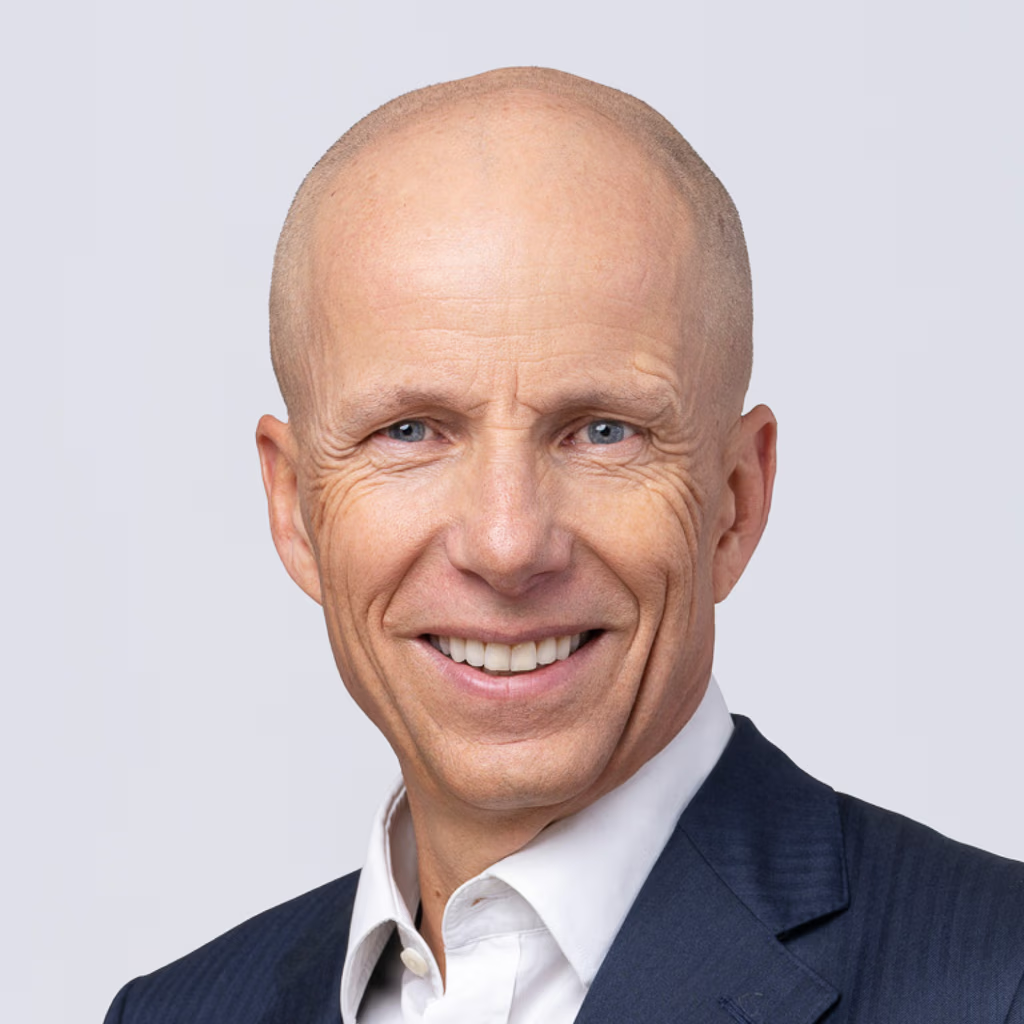
Jean-Christophe Pernollet: “A bank director must understand, ask questions, and make decisions”
As a lecturer at ISFB for the Certificate in Governance and Risk Management for Board Members, Jean-Christophe Pernollet highlights the unique nature of a bank’s board of directors: making decisions without taking over the executive’s role, overseeing without managing, and understanding risks well enough to fully assume its responsibility. This requirement calls for a clear mindset: curiosity, critical thinking, and continuous learning.

Financial Risks: Understanding the Mechanisms to Ask the Right Questions
In this interview, Julien Pelegry, a lecturer at ISFB, emphasizes that bank directors must understand the mechanisms of financial risks—liquidity, credit, interest rate, market, and stress tests—in order to ask the right questions, challenge the experts, and fully assume their governance responsibilities.

Serving on a bank's board involves much more than just a title
As a lecturer at ISFB for the Certificate in Governance and Risk Management for Board Members, Hervé Broch points out that a bank’s board of directors does not create value through its operational involvement, but rather through the quality of its judgment, its questions, and its independence. In his view, governing a bank requires a certain mindset: understanding the bank’s mission, respecting the role of management, engaging in clear debate, and keeping the institution’s long-term sustainability in mind.

Nicolas Dervaux: “Risk is not a constraint; it is an indicator of mastery.”
As a lecturer at ISFB for the Certificate in Governance and Risk Management for Board Members, Nicolas Dervaux points out that the board’s role is not limited to making decisions. It must ask the right questions, set the risk appetite, and hold management accountable. In his view, clear governance links strategy, business lines, regulation, and the institution’s long-term sustainability.
