ISFB Insight
Sustainable Finance: Maturity Calls for New Skills
August 14, 2026
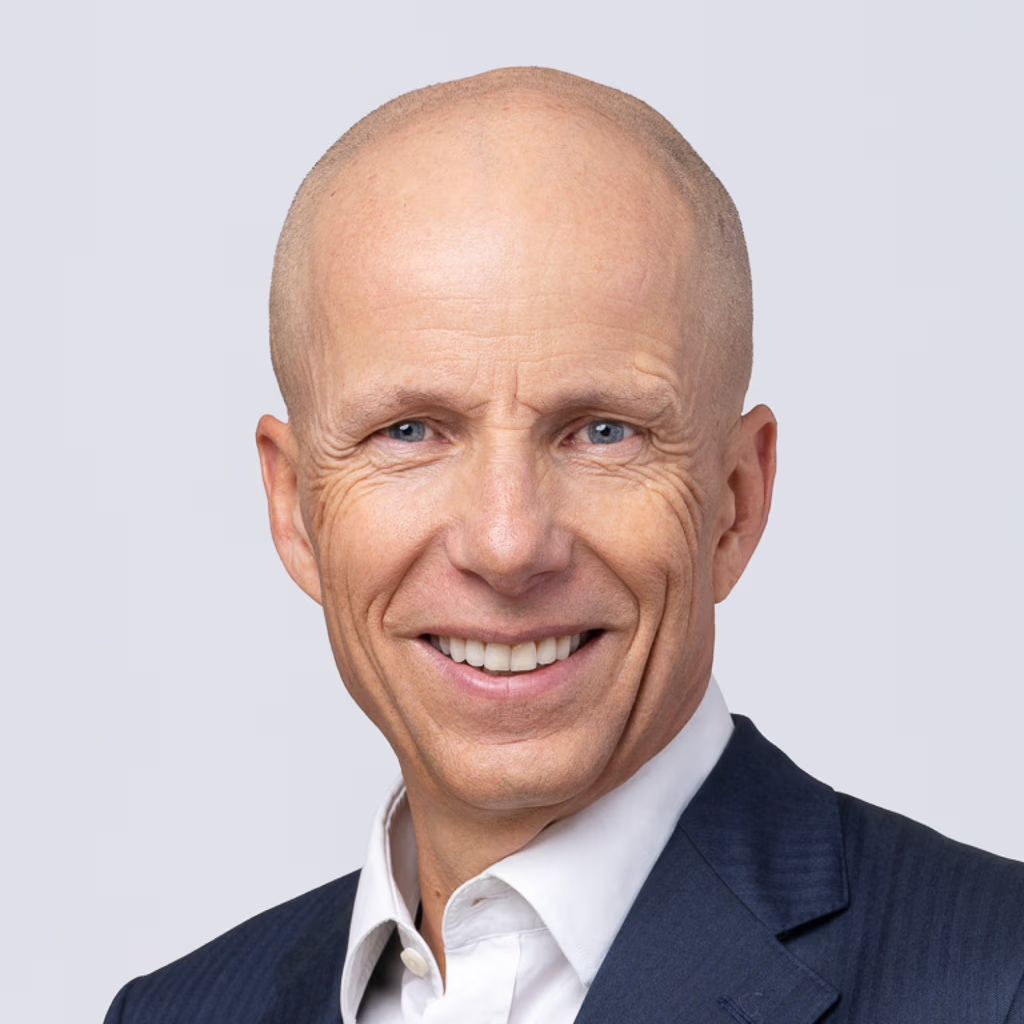
Sustainable finance has entered a phase of maturity, driven by more specific regulatory requirements, better-defined customer expectations, and a more rigorous assessment of its impacts. Antoine Mach, Program Director at ISFB, discusses these developments and the skills they now require of banking and finance professionals. Interview.
Antoine Mach, we interviewed you in 2024 during the launch of the new revision of the ISFB Sustainable Finance Certificate. What has changed the most in sustainable finance since then?
In my view, what has changed the most is the way sustainable finance is perceived, rather than sustainable finance itself. For a long time, this field developed within a specialized ecosystem, relatively independently. It has experienced strong growth since 2015—the year the Paris Climate Agreement was signed—and reached a peak in popularity in 2020–2021. Recent years have been marked by the emergence of regulations and by questions surrounding the major challenges defining sustainable finance: materiality, performance, credibility, and intentionality. Since 2024, I would say that sustainable finance has entered a more mature phase, one that is less tolerant of simplistic narratives and embraces complexity and nuance. We are seeing a rebound in demand for sustainable funds in 2026, with positive inflows in thesecond quarter globally and, for the first time since 2022, in the United States.
Have these developments changed the skills that banking and finance professionals need to master today?
Certainly. Professionals addressing this topic would do well to be familiar with the current state of scientific knowledge on the subject, the views of civil society and younger generations, as well as the intentions of the authorities and the regulations in effect. The goal, of course, is to be able to provide answers to interested clients, but also to know how to ask the right questions—all with a pragmatic, non-dogmatic mindset.
Regulations and the expectations of the authorities have themselves changed significantly. Which changes do you think are the most important today for professionals in the sector?
Several regulations have been adopted or revised in recent years. With regard to investment products, it is therefore important to understand how the Sustainable Finance Disclosure Regulation (SFDR)—which defines categories of sustainable investments in Europe—is evolving. This regulation is widely used to categorize sustainable funds and is therefore a key consideration in investment advice. In Switzerland, the Swiss Bankers Association’s (SBA) guidelines on ESG investments are also an essential reference for industry professionals.
In practical terms, how do these new requirements change the day-to-day work of a banker, an asset manager, or an investment specialist?
The regulatory framework—and, more broadly, public expectations regarding sustainable finance—have evolved. Banks must now assess their clients’ sustainability preferences in order to offer them tailored solutions. This enriches the advisor-client relationship and also requires training efforts for the teams involved. More broadly, I believe it is essential that bankers, portfolio managers, and investment specialists be prepared to meet this demand and capable of stimulating it through creative yet rigorous work in developing their product offerings.
How has the curriculum for the ISFB Sustainable Finance Certificate evolved to reflect these changes?
This program builds on the interdisciplinary foundation of knowledge that characterizes sustainable finance, while closely monitoring and sharing the regulatory, societal, geopolitical, and technological developments that have emerged in recent years. To this end, we are fortunate to be able to count on seasoned practitioners who make up our faculty.
Can we still assume that training completed a few years ago is sufficient in a field that is evolving so rapidly?
Certain concepts, ideas, and approaches remain relevant, of course. But perceptions have evolved, as have the regulatory environment and investor expectations. In a field characterized by rapid change and innovation, it is worth updating one’s knowledge and skills.
Who would you recommend take this course today, including professionals who already have knowledge of sustainable finance?
First, to bankers and advisors who work directly with clients. Second, to bank executives and managers, as well as investment specialists, because sustainable finance is a topic of professional general knowledge that is of strategic importance.
© Institut Supérieur de Formation Bancaire (ISFB). All rights reserved.
The analyses and content published by the ISFB may be quoted or reproduced in part, provided that the source is clearly mentioned. Any full or substantial reproduction of this article in another medium or format is subject to the prior written authorization of the ISFB. In order to facilitate reading and without any intention of discrimination, the masculine gender is generally used, in accordance with the grammatical rule that allows it to be used as a neutral value to refer to a group of people comprising both men and women. This publication is intended for ISFB members and their employees in Switzerland, as well as anyone interested in finance in Switzerland. It is not intended to be read or distributed in any jurisdiction where its distribution would be prohibited.