ISFB Insight
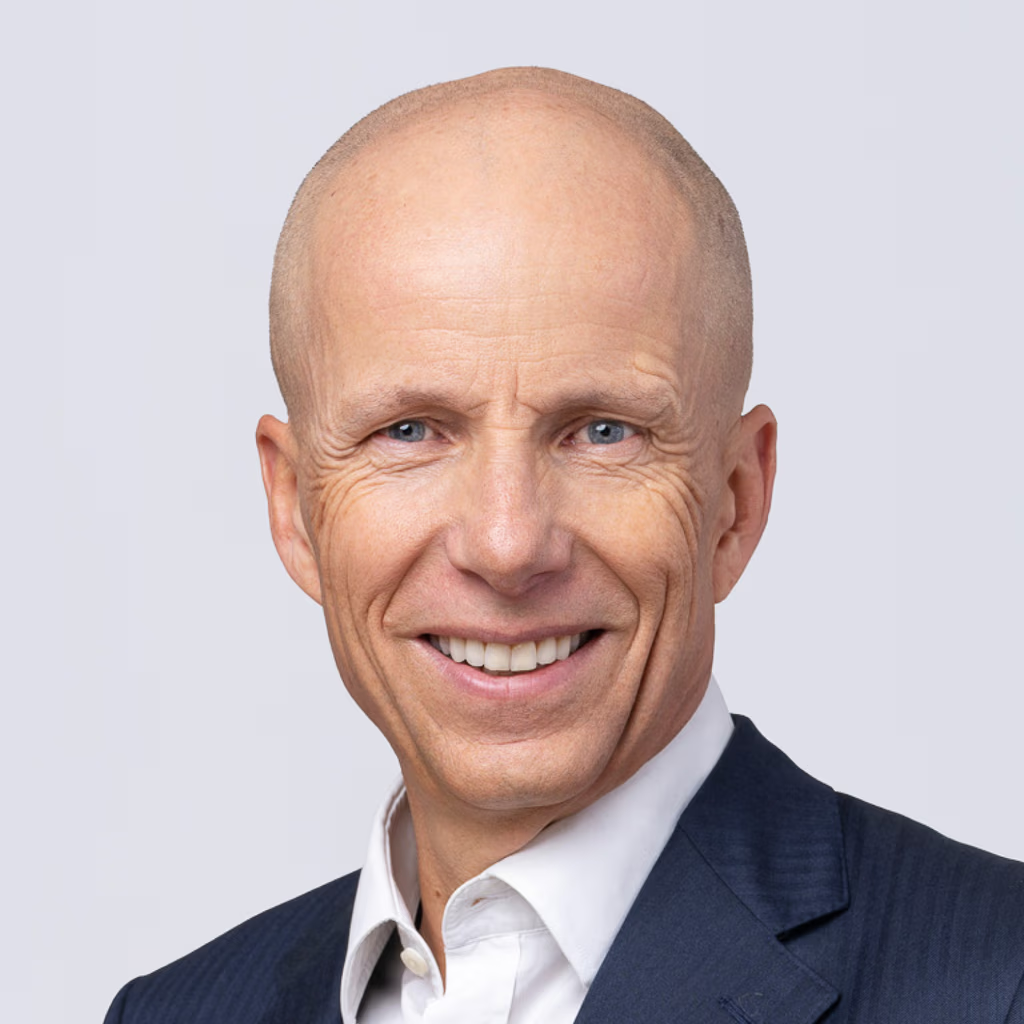
Magaly Aad: Trust as the Foundation of Wealth Management Consulting
July 2, 2026
Coming from a background in investment, Magaly Aad found in wealth management a profession where financial analysis goes hand in hand with the quality of client relationships. As an Assistant Relationship Manager at Arab Bank (Switzerland) in Geneva, she reflects on her career path, her preparation for the SAQ CWMA certification with the ISFB, and how this process has changed her professional practice.
Magaly Add, could you tell us about your career path and what led you to wealth management consulting?
My career path has been shaped by a simple conviction: behind every portfolio, there is a person, a story, and life plans. I come from an investment background, where I learned the rigor of analysis and how to interpret the markets. But it was in wealth management that I found what truly suits me—the intersection of financial expertise and human connection. Today, as a private banking assistant at Arab Bank (Switzerland) in Geneva, what drives me every day is communication, active listening, and building lasting trust with clients. Technical skills can be learned; relationships, however, must be nurtured. It is this conviction that naturally led me to this profession.
When did you feel the need to prepare for the SAQ CWMA certification, and what specifically did you hope to gain from this process?
Coming from a background in investing, I already had a solid grasp of some of the fundamentals. But I wanted more than just a skill: I wanted recognition. A Swiss certification—accredited and rigorous—that attests to a level of excellence in line with the standards of the financial market. The SAQ CWMA certification was the obvious choice. For me, it was less about checking a box and more about a commitment—the commitment to tell clients, with the credibility of a recognized framework, that they are being supported by a professional who invests in her own high standards.
How has the ISFB preparation program benefited your practice—in terms of knowledge, methodology, confidence, or your perspective on the profession?
All four, but in an order I wouldn’t have guessed at first. Knowledge, of course—the program provides structure and depth. Then there’s the method: a more rigorous way of approaching a client situation, of linking every decision to a coherent framework. But what struck me most was confidence. Not the kind of self-confidence that impresses, but the quieter kind that comes from mastery. And beyond all that, a broader perspective on the profession: understanding that wealth management isn’t just a series of products, but long-term support. The program gave me the tools to put into words—and give structure to—what I already sensed intuitively.
The CWMA certification is challenging. Which aspects of the program helped you the most in thoroughly preparing for the exam?
The fact that certification is required is precisely what makes it valuable. What helped me the most was the way the program combines theoretical depth with practical scenarios that closely mirror real-world situations. We don’t just memorize—we understand, apply, and reason. The quality of the instruction also matters immensely—being guided by instructors who know the field from the inside out makes all the difference. Finally, the structure of the program instills a disciplined, consistent work routine, which transforms what could be an intimidating preparation process into a controlled progression. You arrive at the exam not hoping for the best, but knowing you’re ready.
Looking back, what would you say to a banking professional who is still hesitant about taking this training course with the ISFB?
That hesitation often stems from a fear of high standards—and that this is precisely why you need to take the plunge. This preparation doesn’t just require you to learn; it helps you grow professionally. You’ll come away with a more solid foundation of knowledge, a more reliable approach, and, above all, a confidence that shines through in every interaction with a client. I wouldn’t say it’s an easy investment—I’d say it’s a worthwhile one. And in our line of work, where everything hinges on trust, few things are as valuable as knowing that we live up to the trust placed in us.
© Institut Supérieur de Formation Bancaire (ISFB). All rights reserved.
The analyses and content published by the ISFB may be quoted or reproduced in part, provided that the source is clearly mentioned. Any full or substantial reproduction of this article in another medium or format is subject to the prior written authorization of the ISFB. In order to facilitate reading and without any intention of discrimination, the masculine gender is generally used, in accordance with the grammatical rule that allows it to be used as a neutral value to refer to a group of people comprising both men and women. This publication is intended for ISFB members and their employees in Switzerland, as well as anyone interested in finance in Switzerland. It is not intended to be read or distributed in any jurisdiction where its distribution would be prohibited.